AI agent4 min read
Asking an AI agent about past meetings — and why citations matter
A fluent answer about last quarter’s client call is worse than no answer if you cannot open the line it came from. Retrieval with sources is the product; chat without evidence is theatre.
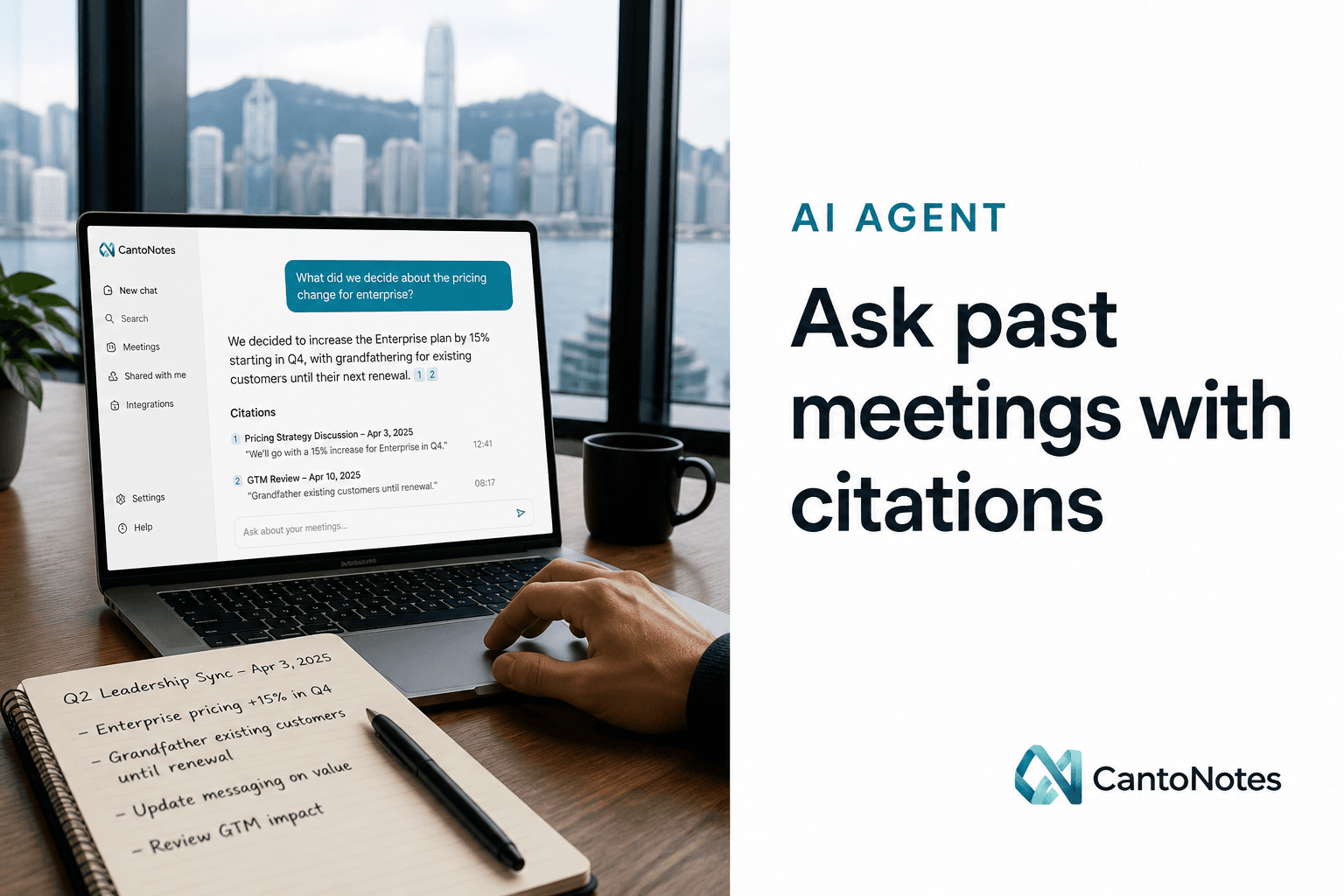
The useful question is rarely “summarize this meeting.” You already have notes for that. The useful questions arrive three weeks later: What did we promise on the SLA? Did the candidate mention a notice period? Which supplier did we actually pick in the Monday standup? Those answers live in a pile of bilingual recordings nobody will replay.
So teams paste a transcript into a general chatbot. The reply is fluent. It is also unaccountable. It will invent a date that “sounds like” last month, merge two clients, or turn a hedge (“我哋再睇下”) into a commitment. If you cannot click back to the sentence, you are reading fiction with good manners.
Citations are how you refuse to trust a vibe
A citation is not a footnote for lawyers. It is the product. Numbered sources that open the note chunk or the transcript window let a human do the only job the model should not do: decide whether the line supports the claim. If the evidence is thin, that should be visible too — not padded into a confident paragraph.
This matters twice as much in Cantonese and mixed speech. A model that “helpfully” renders 再傾 as “we agreed” has changed a commercial fact. You only catch it if you can see the original tokens.
Ask at the right scope
Not every question should search the whole company. Most should not. Scope is how you keep answers relevant and how you keep permissions real.
- One meeting — clarify a decision, draft the follow-up, find who said the price.
- One project — a client account, a hiring round, a squad’s week. Same access rules as the folder.
- Workspace — broader patterns you are allowed to see. Still not “everything anyone ever recorded.”
If an assistant cannot respect project roles, it is not a meeting agent. It is a leak with a chat box. CantoNotes retrieval is filtered by what you can already open. We do not advertise private LLMs or SAML here; we advertise that the answer came from your meetings, with a door back in.
Questions that work in a bilingual workspace
- Ask for a fact with a name: “What discount did Harbour mention in August?” Generic “what did we discuss?” returns mush.
- Ask in the language you remember. If you heard 報價, type 報價. Do not translate your own memory into English first.
- Ask for a list when you need a list: open to-dos on Atlas, not a paragraph about Atlas.
- Ask for a draft only after the facts are cited. “Draft a follow-up” should still show the commitments it used.
If the assistant cannot show its work, it is not cheaper than replaying the call. It is more expensive, because it is faster to believe.
Pasting a transcript into a general chatbot is not a workflow
It feels cheap. It also dumps client speech into a tool with no project permissions, no speaker labels, and no obligation to show a source. You cannot ask “only this account” when the paste is already a blob. You cannot prove a quote. You cannot keep the intern from pasting the wrong folder.
A meeting assistant has to live where the meetings already live. That is the unglamorous requirement hiding under every demo GIF.
What the agent is not
It is not a replacement for minutes on the day of the meeting. Write or generate those first. It is not a CRM. It will not push to Slack, Notion, or Jira. It is not unlimited: agent messages consume credits, same as processing audio, so usage stays visible. Mobile and desktop apps that would let you ask on the MTR are still coming; the web workspace is where this lives today.
Used honestly, the assistant is the search bar you can talk to — across Cantonese, English, and the mix — with the same standard you would demand from a colleague: say where you heard it. That is the entire feature.
A practical Tuesday: you have six calls on one client, two in Cantonese, one mixed, one in English with a visiting principal. You should be able to ask “what did we promise on the trial period?” and get three cited lines, not a blended paragraph that names the wrong AE. If one of those lines is a hedge, you want to see the hedge. That is how a workspace earns the right to sit next to the CRM — not by sounding smart, by staying checkable.
If your team still pastes transcripts into a consumer chat window after reading this, the blocker is usually permissions anxiety (“I do not want the intern in every folder”) rather than model quality. Fix the project roles. Then the assistant becomes safe enough to use on the questions that actually waste your week.