Action items4 min read
How to turn a bilingual Hong Kong meeting into minutes and owner-ready to-dos
The recording is not the job. The job is a two-minute read plus a list of who does what by when — even when the room mixed Cantonese and English.
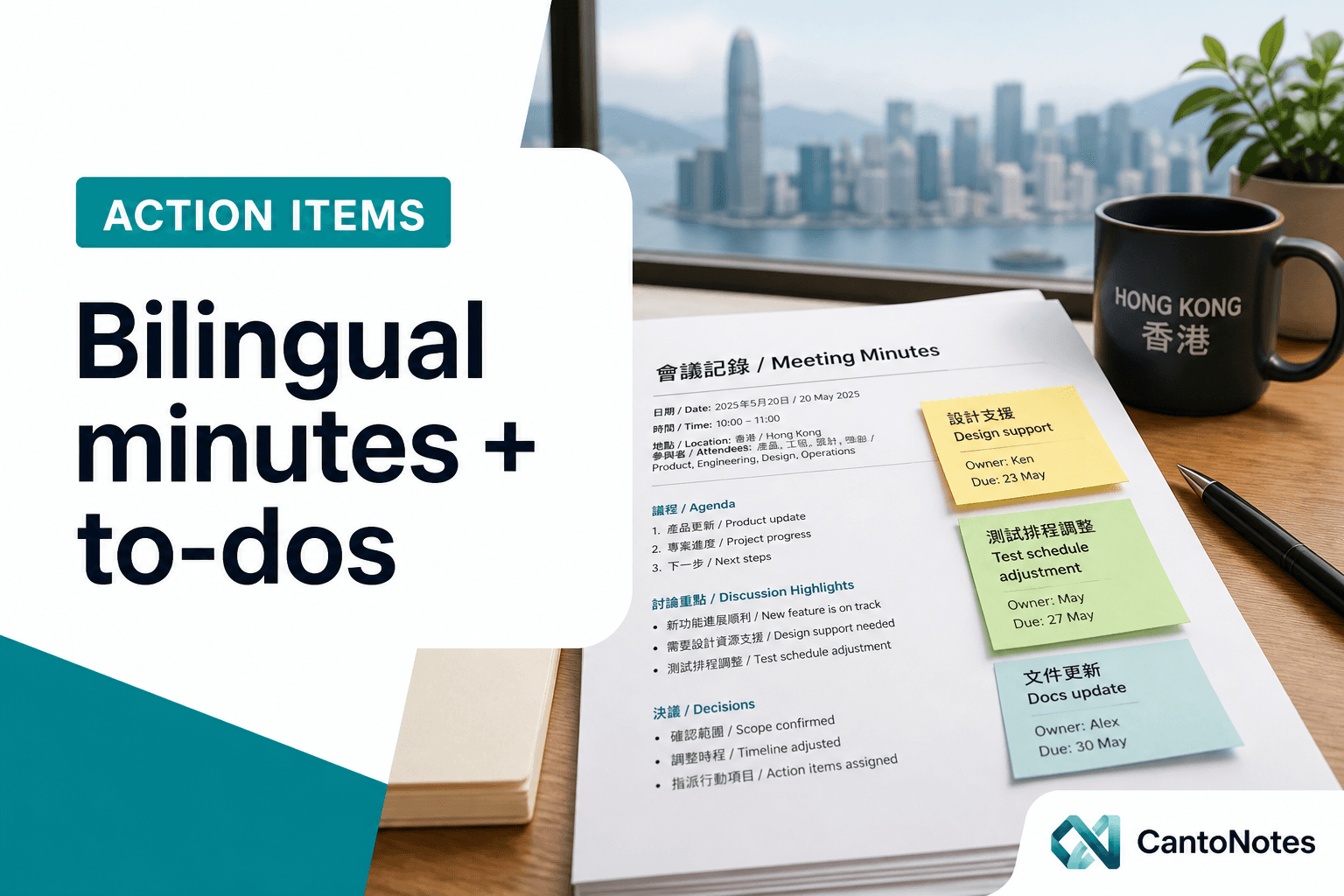
The meeting was fine. Then someone has to write it up. In Hong Kong that often means a bilingual call — Cantonese for the argument, English for the SKU, a date said two ways — turned into a document the absent director can trust. The usual method is replay, pause, type, WhatsApp the owner to confirm. It leaks into the evening.
You do not need cinema-grade subtitles. You need minutes that pass a simple test: a teammate who missed the call should be current in two minutes, and every commitment should already look like a to-do with a person on it. This note is the workflow, not a tool pitch with the workflow taped on.
Minutes are not a transcript with the ums removed
A transcript is the tape in text form. Minutes are a document with a job: what we decided, what is still open, who owns the next move. If you paste the transcript into an email, readers skim for names and dates and miss the decision buried in turn 47.
For mixed-language meetings, the temptation is to “standardize” everything into written English or written Chinese. That can be right for a client-facing recap. It is the wrong first step. First capture what was actually said; then write the minutes in the language the recipients will file. Mixing those two jobs is how names get “helpfully” translated and the wrong legal entity ends up in the PDF.
Listen for commitments, not just topics
Hong Kong meetings hide to-dos in casual speech. “你跟進吓” is an assignment. “星期五前交” is a due date. “我哋下星期先 decide” is a decision to delay — which still needs an owner, or it dies. English fragments do the same: “Can you send the deck?” inside a Cantonese paragraph is still a to-do.
- Who — a name or a function (“sales”, “CSM”), not “the team.”
- What — a verb and an object, specific enough that you could check it on Friday.
- When — a date or a meeting (“before the Thursday standup”). No when means it is a wish.
- Priority — if two items collide, the room usually said which one comes first. Keep that.
If the last five minutes of your meeting never recap owners, the notes file will guess. Spend those five minutes out loud: read back the list. It is cheaper than a 11 p.m. reconstruction.
Speaker labels are how owners stay honest
A to-do without a speaker is easy to mis-assign. “We’ll send the quote today” might be the AE promising the client, or the client promising internal paperwork. Label who said the line. Then the owner of the to-do is either that person, or the person they named.
This is also why a single shared recording dump fails. Client calls and internal post-mortems should not live in one folder with the same access. Put the meeting in a project (one client, one squad, one round of interviews). The to-do list then belongs to that project, not to whoever happened to host the Zoom.
A write-up shape that survives a bilingual call
- Header: date, attendees, project or account name — in the form you already use in email.
- Summary in one short paragraph. If it needs three, the meeting had three topics; split them.
- Decisions as sentences, not vibes. Include the option you rejected if it will come back next week.
- To-dos as a list with owner and timing. Keep the original language of the commitment if the owner is local; translate only the customer-facing recap.
- Open questions separately. Unresolved is not a to-do until someone owns the next step.
Export comes after that shape exists. PDF for the client, Markdown for your archive, a to-do list that still lives in the workspace. Do not start from the export format and hope the thinking appears.
Where software actually helps — and where it should not pretend
Transcription gets you the tape. Extraction gets you candidate to-dos. Neither replaces a human glance when the stakes are a contract. The useful bar is: after the call, the draft minutes and the draft list are already there, in the same place as the recording, with speakers labeled. You correct an owner; you do not start from a blank page.
CantoNotes is built for that bar. A meeting bot or an upload becomes a transcript plus notes plus to-dos, filed in a project, with roles so the client folder is not the whole company. You can ask the AI assistant to draft a follow-up from the meeting; the answer should still show the source line. It will not invent Slack or Jira push, and it will not claim unlimited meetings — processing uses credits, which is the honest version of “how much did we transcribe this month.”
If your team still ends the week asking “邊個負責?”, the minutes pipeline is not done. The bilingual part is the speech. The professional part is the list.