Meeting notes4 min read
Meeting notes vs a raw transcript for Hong Kong teams
You need both, for different jobs. The transcript is evidence. The notes are how the rest of the company catches up — if they can be read in two minutes.
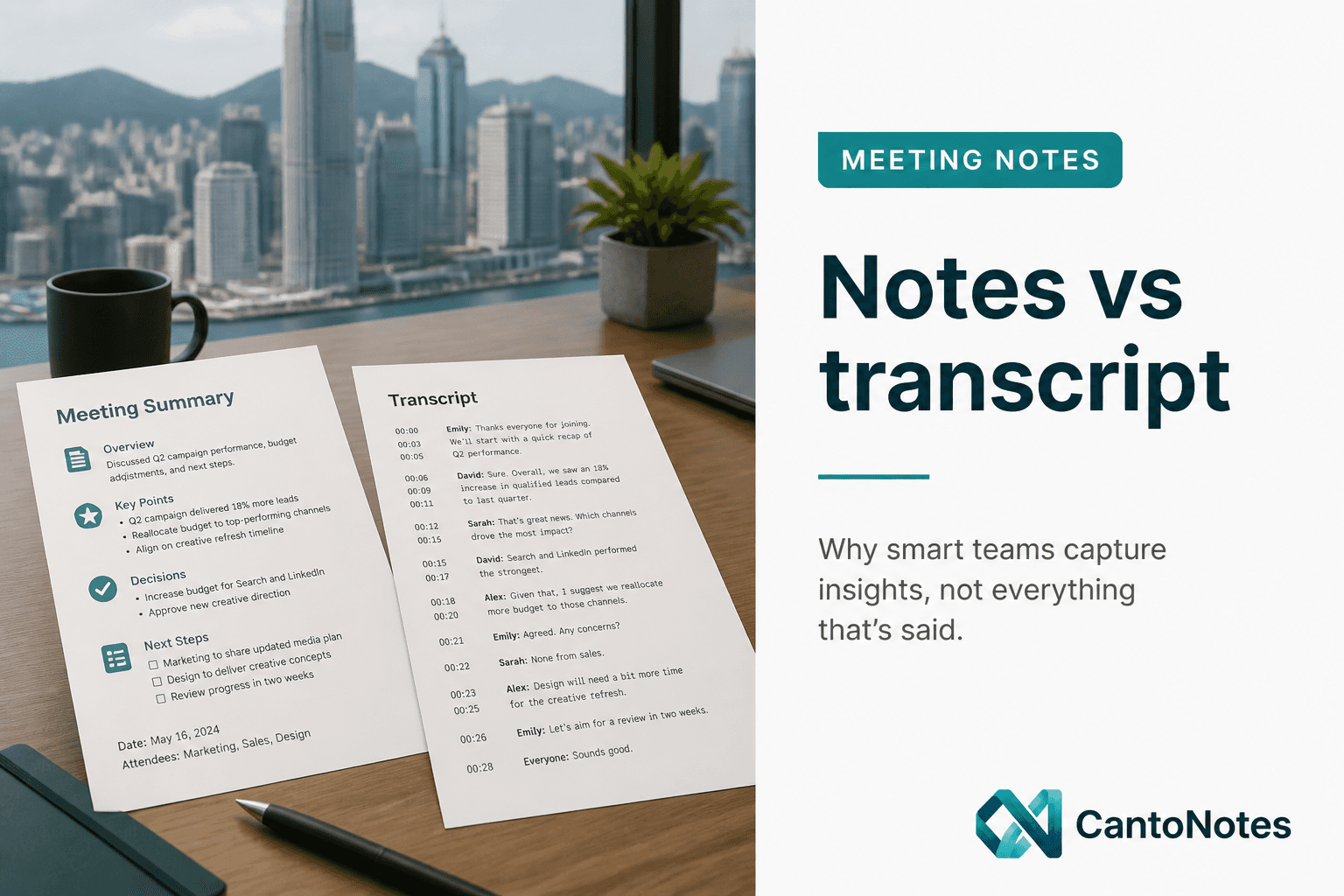
After a bilingual call, someone asks for “the notes.” They might mean three different objects: the recording, a word-for-word transcript, or a one-page recap with decisions. Mixing those words is how a 40-page paste lands in a director’s inbox, and how a fluffy summary gets used in a dispute where you needed the exact line.
Hong Kong teams feel this more than English-only offices. The transcript is long because people repeat themselves across two languages. The minutes have to be short because nobody will read a dual-language wall. You still need the long form, sitting right next to the short form, or you will lose arguments you already won in the room.
The two-minute test for notes
Good meeting notes pass a cruel test. A teammate who was on leave opens the page and, in two minutes, knows: what we decided, what is still open, and whether anything is theirs. If they have to scroll a transcript to find that, you did not write notes. You stored audio as text.
That test is why “AI notes” that are actually a slightly shorter transcript fail. Compression without structure is still a wall. Structure means labeled chunks — summary, discussion, decisions, to-dos — not a paragraph that tries to be all four.
When you need the transcript, not the recap
- A quote will be reused: press, legal, a customer complaint, an interview score.
- Someone will disagree about what was promised. Minutes describe; the transcript shows the sentence.
- You are handing work to someone who was not in the industry conversation and needs the actual wording of a spec.
- You want to search a phrase you remember hearing, not a manager’s paraphrase.
For those jobs, a polished recap is a liability if it is the only file. Polished language hides particles and code-switching that change the meaning. Keep the transcript. Make it labeled by speaker. Make it searchable.
When notes should be the default open
Standups, weekly ops, training recaps, most internal QBRs: people need the outcome, not the performance. Notes are the index. The transcript is the footnote. If your culture opens the footnote first, the index is not good enough yet.
Write notes in the language the readers will file. A local squad can keep a Cantonese summary. A group with a London stakeholder may need an English recap. The transcript underneath can stay mixed. Do not force one language on both layers just to look tidy.
Search needs both layers
Keyword search on a transcript finds the word and misses the decision. Search only on notes finds the decision and misses the odd phrase you actually remember (“嗰個 thirty-eight萬”). Semantic search across both is the adult version: you ask for meaning, and you can still open the line.
This is also why a Zoom companion note that evaporates into that meeting’s sidebar is a dead end. Memory is a workspace problem. Notes without a home, and transcripts without notes, both fail at the six-week mark.
Who owns the file — and who is allowed to open it
Notes without access rules become gossip. A hiring transcript in the same Drive folder as the all-hands recap is how a candidate’s salary expectation leaks. Put the meeting in a project with roles before you argue about minutes versus transcript. Viewer can read both artifacts. Editor can fix a name. The assistant later inherits the same door.
If your current habit is “whoever hosted the Zoom keeps the link,” you do not have a notes culture. You have a bottleneck. The host going on leave should not take last month’s decisions with them.
One meeting, two artifacts, one project
- Capture once (bot or upload). Do not keep a second unofficial recording in someone’s Drive.
- Store transcript and notes together, with the same speakers and the same timestamped source.
- File them in a project so client work is not mixed with internal standups.
- Let to-dos hang off the notes. Let quotes hang off the transcript. Do not make people pick a single export as the source of truth.
CantoNotes is deliberately both: full transcript plus notes you can actually send, plus to-dos, in a project you control. Paid plans can export Markdown, PDF, and SRT when you need a file to leave the building. The point is not to pick notes or transcript. The point is to stop treating them as synonyms.
A useful house rule: the notes page is what you share in the stand-up chat; the transcript is what you open when someone says “I never agreed to that.” If those two files live in different tools, people will only keep the short one, and you will lose the argument you already won. Keep them together even when you are sure nobody will reopen the tape. The six-week-later you is a different reader.
If you only have budget for one artifact this quarter, keep the transcript. You can write short notes later. You cannot reconstruct a mixed-language quote from a manager’s recap. The product pitch is that you should not have to choose — but if you must, choose evidence.